Contributors

Showing posts with label nursery web spiders. Show all posts

Monday, February 27, 2012

The six-spotted fishing spider--


Dolomedes triton

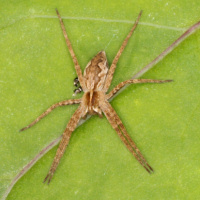
More commonly known as the six-spotted fishing spider, this spider can be found almost everywhere in North America, in South america sometimes too. Females, without legs, can be up to 20 mm long (.79 in), and with legs up to 90 mm (2.4 in). Males, without legs, are 9-13 mm (.35-.51 in) long. I would tell you how big males are with legs but none of my sources said, and even when I googled it I couldn't find anything. :( But I can surely continue this post while still missing that piece of information. This spider is called such because it has six spots on its back separated into three rows of two, as seen above. It can be a green-ish color or grey-ish and also brown-ish. As with all fishing spiders, they prefer to live in a place where water is abundant, because it will eat minnows, tadpoles, and also insects that live near water, such as mosquitoes and dragonflies. They are able to walk on the water because their eight legs even dispute the weight of the spider, making each leg lighter than the water, therefore floating and walking is a natural ability. Eggs are lain in the summer, and the female will encase the egg sac in a "nursery web" until they hatch. Sexual Cannibalism in present in this species. **The picture in the top left is the eye arrangement pattern of Dolomedes.**

Monday, February 20, 2012

Dark Fishing Spider--

Dolomedes tenebrosus

Dolomedes tenebrosus, also called the dark fishing spider, is a medium to large sized fishing spider. Males, without legs, are 7 - 13 mm (about .2 - .5 in), and females, also excluding legs, can be around 15 - 26 mm (approx. .2 - 1 in). Including legs, they can be (male and female alike) 50 - 90 mm, or 2 - 3.5 inches. They aren't fatal, and symptoms of the bite are quite similar to those of a bee sting. But as some people are more sensitive, and sometimes allergic, to spiders, they may experience harsher reactions. The bodies of this spider - males and females don't really differ from each other other than size, and, of course, gender - are brownish-grey, with lighter brown and black stripes going down the legs. Like a lot of spiders in this family, it will cocoon things in its web, sometimes even trees!

Sources:

Monday, February 13, 2012

Nursery web spiders, fishing spiders--


Family Pisauridae

Nursery web spiders and fishing spiders are in the same family, which is the family Pisauridae. Sexual cannibalism (when the female eats the male after mating) is common in the family, so the male will give the female a gift before to ease her hunger a little bit, so that the male will have more time to mate before the female gets hungry again. An inedible gift, such as an exoskeleton of a bug, means the least amount of time, while a horsefly (Mmmm, delicious... NOT!), which is a treat for spiders of these sorts, will ensure more--but not infinite--time for the spiders to reproduce before the female eats him. They can walk on water, and will sometimes dive under to get tadpoles, small fish, and sometimes worms. On dry land, they will eat any insect that gets ensnared in their web. It closely resembles wolf spiders, although one difference is the eye pattern of each. Nursery web spiders have four eyes on the bottom forming a straight line and four on the top in a sort of U shape. Wolf spiders have eight eyes as well, although they have two large, main eyes, four other ones on the bottom forming a downward curve, and two smaller ones on the top that seem like oval-ish slits. For more information about their eye arrangements, click here. Females, once the egg sac is laid, will carry it with her by using her fangs. When it is nearing the time for the eggs to hatch, she will suspend it off of a web until they hatch, and will remain there until all of her spiderlings have dispersed. pictures are right here, too, if you are interested in other photos than what I have shown above.