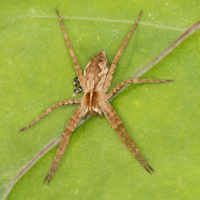
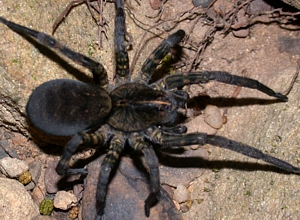
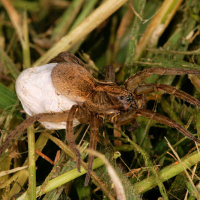
More commonly known as the six-spotted fishing spider, this spider can be found almost everywhere in North America, in South america sometimes too. Females, without legs, can be up to 20 mm long (.79 in), and with legs up to 90 mm (2.4 in). Males, without legs, are 9-13 mm (.35-.51 in) long. I would tell you how big males are with legs but none of my sources said, and even when I googled it I couldn't find anything. :( But I can surely continue this post while still missing that piece of information. This spider is called such because it has six spots on its back separated into three rows of two, as seen above. It can be a green-ish color or grey-ish and also brown-ish. As with all fishing spiders, they prefer to live in a place where water is abundant, because it will eat minnows, tadpoles, and also insects that live near water, such as mosquitoes and dragonflies. They are able to walk on the water because their eight legs even dispute the weight of the spider, making each leg lighter than the water, therefore floating and walking is a natural ability. Eggs are lain in the summer, and the female will encase the egg sac in a "nursery web" until they hatch. Sexual Cannibalism in present in this species. **The picture in the top left is the eye arrangement pattern of Dolomedes.**
Showing posts with label spiders. Show all posts
Monday, February 27, 2012
Monday, February 20, 2012
Dark Fishing Spider--
Dolomedes tenebrosus
Dolomedes tenebrosus, also called the dark fishing spider, is a medium to large sized fishing spider. Males, without legs, are 7 - 13 mm (about .2 - .5 in), and females, also excluding legs, can be around 15 - 26 mm (approx. .2 - 1 in). Including legs, they can be (male and female alike) 50 - 90 mm, or 2 - 3.5 inches. They aren't fatal, and symptoms of the bite are quite similar to those of a bee sting. But as some people are more sensitive, and sometimes allergic, to spiders, they may experience harsher reactions. The bodies of this spider - males and females don't really differ from each other other than size, and, of course, gender - are brownish-grey, with lighter brown and black stripes going down the legs. Like a lot of spiders in this family, it will cocoon things in its web, sometimes even trees!
Sources:
Monday, February 13, 2012
Nursery web spiders, fishing spiders--
Family Pisauridae
Nursery web spiders and fishing spiders are in the same family, which is the family Pisauridae. Sexual cannibalism (when the female eats the male after mating) is common in the family, so the male will give the female a gift before to ease her hunger a little bit, so that the male will have more time to mate before the female gets hungry again. An inedible gift, such as an exoskeleton of a bug, means the least amount of time, while a horsefly (Mmmm, delicious... NOT!), which is a treat for spiders of these sorts, will ensure more--but not infinite--time for the spiders to reproduce before the female eats him. They can walk on water, and will sometimes dive under to get tadpoles, small fish, and sometimes worms. On dry land, they will eat any insect that gets ensnared in their web. It closely resembles wolf spiders, although one difference is the eye pattern of each. Nursery web spiders have four eyes on the bottom forming a straight line and four on the top in a sort of U shape. Wolf spiders have eight eyes as well, although they have two large, main eyes, four other ones on the bottom forming a downward curve, and two smaller ones on the top that seem like oval-ish slits. For more information about their eye arrangements, click here. Females, once the egg sac is laid, will carry it with her by using her fangs. When it is nearing the time for the eggs to hatch, she will suspend it off of a web until they hatch, and will remain there until all of her spiderlings have dispersed. pictures are right here, too, if you are interested in other photos than what I have shown above.
Monday, February 6, 2012
The Banded argiope--
Argiope trifasciata
Argiope trifasciata is called such because of the black, white, and yellow bands on it's back. In fact, trifasciata means "three-striped" in Latin. You know, is you input "three-striped" into the Google Translate™ bar from English to Latin, you will receive something sounding very close to "trifasciata." The banded argiope has a darker underside than it's back. Females can be up to (not counting legs) 1 inch long, and males only up to 1/4 of an inch, also excluding legs. The legs have two pairs jutting out forwards and another two pairs extending backwards. Like all orb weavers, it has eight eyes, four main eyes in the middle of it's face and four others, two smaller ones on each side of it's head. Males mature at a different time than the females, in the summer, while females mature in fall. This species prefers drier climates than it's fellow orb weavers and argiopes. Males will die shortly after mating, while females die at the first frost after laying her eggs. Some females might lay more than one egg sac. Egg sacs are flat on one side, rounded on the other, much like a kettle drum. The prefer to build their webs closer to the ground than other spiders. You want to see some pictures? They can be found right here! Yippee!! Yahoo! Yay! Yeehaw!! Go argiopes! Hehe. Well, just remember, that isn't all there is to know about banded argiopes, so go do some research of your own! Also, it would be fun to take a little nature walk and see what plants, animals, and bugs you can identify!
Sources:
Monday, January 30, 2012
Black and yellow argiope
Argiope aurantia
The black and yellow argiope is another orb weaver, and might possibly be confused with the golden silk orb weaver, but actually are quite different. Every night the female black and yellow argiope will eat her web and build a new one in the morning. Both genders are black with yellow and/or red stripes on it's back. The male will wander around looking for a mate in the early fall. The male will build a smaller web near the female's and will try to seduce the female by plucking the silk strands on her web. He then travels up her web, a safety line ready, in case the female tries to attack. The female will lay her egg sac in the fall and will usually die at the first frost. The babies will hatch from their eggs in the fall, maybe a few weeks after being lain. They will stay in the egg sac until spring, when they come out and travel by ballooning* to a different area. Females are significantly larger than the males, as with most spiders, males can be (excluding the legs) up to 1/3 of an inch long, and females can reach up to (also excluding the legs) 1.1 inches long. They will eat most any insect or bug that is smaller than them, although they have many predators too, such as the Carolina Chickadee (will try to do a post in the summer), the Striped skunk, the common yellowthroat, many other birds, some types of ducks, and a few large insects. Want to see some more of these big boys? Neat pictures can be found at this website. And, according to the people at carolinanature.com, argiope is pronounced ar-GUY-oh-pee. Who knew? Definitely not me. Wanna check out some more photos? More are located right here! Click it! You know you wanna... Just one more tidbit of information: this spider, like most orb weavers, is harmless to humans. Well, stay tuned, because next week is going to have EVEN MORE ORB WEAVERS!!! Yippee!
Sources:
*Ballooning is when a spiderling will use a strand of silk to float in the air and carry it farther than they're able to walk.
Monday, January 23, 2012
Golden Silk Orb Weaver--
The golden silk orb weaver--also known as the "banana spider," because of it's shape--is one of the largest--and the creepiest, I have to say--spiders I've heard of. As you can see, it is very big, seeing as it's about as big as an adult's hand. And to add to the creepy-meter, it's elbows are furry. A lot of times, because the spider is so big, when people see it, they want to kill it. But this spider is beneficiary to your house. It loves to eat mosquitoes, flies, sometimes even other spiders! So, instead of smushing it, get a long stick, and slowly wind the web around the stick, in a spiraling motion. The spider will follow it's web, and once the spider is on the stick, quickly move it to a spot that pleases you. The females of this species will sometimes eat their webs when they are done with it. And this spider is venomous, but not lethal. It usually causes redness, swelling, and itching, much like the reactions you get fro a black widow's bite, although it isn't as potent. In the fall and winter, the females with lay their egg sacs on a tree that is near the webs. The egg sacs are about an inch in diameter. The females' bodies are about two inches long, and with legs outstretched, they can be 4-6" wide. The males are noticeably smaller than the females, with their bodies being only 1/3 of an inch long. Crazy, huh? The Golden Silk Orb Weavers are called such because the adults' silk is a beautiful golden color. Did you know?: One million female orb weavers from Madagascar made this extraordinarily unique cloth from spider silk. I'm simply astonished at the amazing beauty of this wonderful piece of art. Wow, just wow. Who knew? Well, someone in the late 1890s thought they would try it, and they wove only a small piece, almost nothing compared to the vast size of that wonder. Well, I believe I am done for the day! See you next week! Buh-bye.
Wednesday, January 18, 2012
Spiny-Backed Orb Weaver--
Gasteracantha elipsoidesThe spiny-backed orb weaver (you can obviously tell why it is called such) is quite easy to identify, as the spines on it's back are uniquely conspicuous. Spiny-backed orb weavers--also spelled Spinybacked, and Spiny Backed--usually have at least two colors on them, and are usually red, white, yellow, black and/or orange. It spans all across the southern United States from North Carolina to southern California. It is usually 0.08 in. to 0.4 inches, and you can see a comparison here. Like most orb weavers, the adults lay their eggs in fall-winter, die in the afterwards, and let their eggs hatch in the later. Although males have been found in every month--except December and January--they are most common in October and November. Females are found year-round, but they are most common in October-January. They are poisonous, but not poisonous to harm a human. Probably not even harmful enough to hurt a gerbil. Not saying that that I tried it, though... In October-January, the females will lay their eggs on the underside of a leaf, much like many butterflies do. The eggs hatch after about two weeks, after which for a few days they remain in a pink and white stage until molting into their adult figures, but still small, as are their webs. In late summer-early fall both their webs and bodies grow significantly in size. They live their boring lives until October, when they begin to mate. Webs can be from 1-7 yards from the ground.
Sources:
Monday, January 9, 2012
Orb Weavers--
Family: AraneidaeGenus: Araneus
That spiny-backed orb weaver on the left looks pretty neat, huh? And on the right is a comparison between male and female orb weavers. Guess which one the male is? That would be the tiny speck near the top of the picture. Who knew that the female (if she could) would easily be able to swallow him whole. But she can't, luckily. Orb weaver females are usually the only ones to spin webs, as the males are usually on the ground trying to find a mate. This makes the females the ones most seen by humans. They spin webs very large, up to six feet or more in width. Just watch where you're going, as one of My sources say, just "be careful not to walk into their webs at night--the fright of this spider crawling over one's face can be terrifying and may cause a heart attack...*" Yes.
Absolutely true, I say. And don't worry about getting bitten; their venom is not powerful enough to harm a human, although, as with all spider-bites, they should be washed thoroughly, as to prevent infection. Orb weavers make the kind of web that you would normally think of when you say "spider webs"(see image on the right). Some of them will make beautiful and intricate patterns on their webs. Most likely, Charlotte, from Charlotte's Web, was an orb weaver. Orb weavers lay their eggs in the late summer to fall, after which they die at the first frost. The eggs will survive through the winter, hatch in spring, mature in the early summer, and then
start the cycle all over again. Well, it's time for my post to die, but its eggs will hatch next week! Good-bye!
Monday, January 2, 2012
Crab Spider--
Misumena vatia
The goldenrod crab spider is what my focus is this week! Another name that is used for this creature is the flower spider. It is yellow all around, and the young females can change colors at will, but over a long period of time. Changing from white to yellow take a little less than a month, about 10-25 days, while changing from yellow to white takes only about six. The reason crab spiders can change colors is because of a liquid yellow pigment they make secreting into the cells of the spider. It takes longer time to change from white to yellow, because the spider has to make the pigment before she can distribute it into her cells. The crab spider usually lives in flowers such as dandelions, which they blend in well with the petals, and sometimes the females will go to daisies, and change color to white. In spring and summer, the crab spider will eat bees and wasps pollinating the flower that little Miss Spider lives in. Crab spiders in general are called so because their front legs curve forward, much like the claws of a crab. In the picture above, the crab spider is pretending to be a flower. This may happen if one cannot find a flower to latch onto. Crab spider eggs are lain in late spring and summer. They will also eat mites, flies, butterflies, and pretty much anything it can get it's mouth on.
Wednesday, December 21, 2011
Wolf Spiders--
Lycosidae
Wolf spiders are particularly large spiders, as with the legs outstretched, they can be up to 4" long. Although, they range in size, with body lengths ranging from 1/4" to 1". They do not usually build webs, as they stalk their prey rather than wait for the meal to come to them. In fact, they got the name because of that habit, stalking their prey, because wolves do that as well. They hardly ever go into houses, and they most likely do that because a door was left open. Because of their rather big size, they can't slide in through cracks under the door. Wolf spider bites are very rare, and as harmful as a bee sting. In fact, bee stings are more common than wolf spider bites, because bees have to protect their hive, whereas wolf spiders are quick enough (most of the time) to evade capture. Wolf spiders only bite when handled or picked up, so if you find one, gently guide into a big enough container with a stick or pencil. They can be black and brown, and hairy. They resemble tarantulas in appearance, but are not. They have very good eyesight, and the females usually attach the egg sac onto her spinnerets until the babies hatch, as seen above. The wolf spider has eight eyes, four on the bottom, two extra big ones in the middle, and two medium sized eyes at the top. In total, there are more than 2000 wolf spider species. Wolf spider bites are usually emitted by the larger species, as the smaller ones do not have the ability to penetrate skin. It may swell, turn red, itch, but usually it goes away within a few hours. Because the bite may get infected, wash it frequently so this will not happen.
Tuesday, December 13, 2011
Loxosceles reclusa-The Brown Recluse
The brown recluse spider is venomous, as venomous as a black widow. It is about the size of a quarter, and is noted for the violin shaped marking on its head, with the "neck" of the violin pointed at towards the spider's back. The prefer to build their webs in dark, dry places. This makes them different from the black widow, because the black widow prefers dark, moist places to live.
The brown recluse' bite is a large, red, swelling blotch, followed by nausea, vomiting, restlessness, fever, and shock. After the bite turn red, it turns into an ulcer. If left untreated, it can--but not always--cause the victim to die, as the black widow's can too. The ones most likely to be the most affected by the venom are children under the age of sixteen, and the elderly. The red mark on your skin can both: be 1-2 and 3/4 inches long; and once it heals, it can leave ugly scars.
The brown recluse is mostly found in the mid-south, including Texas, Oklahoma, Alabama, Louisiana, Mississippi, and Arkansas. Though it can live almost anywhere. The most common ways for a brown recluse to change its home is to move with you in old boxes that haven't been opened in a long time. Some of the most common times that a brown recluse with bite is if you are getting dressed, and the spider was hiding in your apparel, and if putting on shoes that the recluse was nesting in. The brown recluse hardly ever bites you in your sleep, as it usually only bites when in danger, and your weight would most likely squash the recluse before it could bite. They will only nest in places where they can find food, so if you keep all pests out of your house, the recluse will have to leave as well. The same is true for all spiders, and bugs that eat other bugs, such as ants. Yes, I have seen ants carrying a granddaddy long legs to their hill. I actually thought it was a large crumb at first, but then I saw the legs, and I thought: "Wow, I've never seen that before!" I was surprised. Well, that is what I know! And stay tuned, because holly bushes and trees are starting to get berries! So I will be editing my post to include those as well. Bye-bye, and I hope to have more readers next week!
The brown recluse' bite is a large, red, swelling blotch, followed by nausea, vomiting, restlessness, fever, and shock. After the bite turn red, it turns into an ulcer. If left untreated, it can--but not always--cause the victim to die, as the black widow's can too. The ones most likely to be the most affected by the venom are children under the age of sixteen, and the elderly. The red mark on your skin can both: be 1-2 and 3/4 inches long; and once it heals, it can leave ugly scars.
The brown recluse is mostly found in the mid-south, including Texas, Oklahoma, Alabama, Louisiana, Mississippi, and Arkansas. Though it can live almost anywhere. The most common ways for a brown recluse to change its home is to move with you in old boxes that haven't been opened in a long time. Some of the most common times that a brown recluse with bite is if you are getting dressed, and the spider was hiding in your apparel, and if putting on shoes that the recluse was nesting in. The brown recluse hardly ever bites you in your sleep, as it usually only bites when in danger, and your weight would most likely squash the recluse before it could bite. They will only nest in places where they can find food, so if you keep all pests out of your house, the recluse will have to leave as well. The same is true for all spiders, and bugs that eat other bugs, such as ants. Yes, I have seen ants carrying a granddaddy long legs to their hill. I actually thought it was a large crumb at first, but then I saw the legs, and I thought: "Wow, I've never seen that before!" I was surprised. Well, that is what I know! And stay tuned, because holly bushes and trees are starting to get berries! So I will be editing my post to include those as well. Bye-bye, and I hope to have more readers next week!
Monday, December 5, 2011
Black Widows-
Southern Black widow, or Lactrodectus mactans
I have never seen a black widow for more than ten seconds before, so I don't have any pictures to show you. But, I can tell you some things about them. Females are most recognizable by a distinct hourglass marking on their under-abdomen. Females are always black, with a glossy tint. Males can be black, but are usually red or brown. The black widow in general, whether it be male or female, has a cephalothorax that is much, much smaller than the abdomen. The abdomen is shaped somewhat like a sphere, very round, and large. The venom of the female black widow is rarely fatal, if given immediate medical attention. The usual signs of a black widow bite are nausea, vomiting, sweating, cramps, faintness, headache, itching, and increased blood pressure, to name a few. If bitten by a black widow, or, now that I think about it, any spider at all, instantly seek medical attention. Black widows, despite their notorious reputation, are not as aggressive as you might think. Even if disturbed in it's own web, a black widow will most likely try to run away rather than bite. To prevent spider bites, wear heavy gloves when working outside, especially when reaching into unseen places, such as in a log, under a log, under a house, etc. Black widows prefer to have their webs close to the ground, or a solid surface, such as a large shelf. Don't worry about juveniles, whether male or female, because they are harmless to humans. Try to keep your smaller pets (such as small dogs and cats) away from places where a black widow might be, because us humans are big, so there are only small traces of venom in our blood, where as cats, for example, have less blood, so there will be larger amounts of the venom in Mr. Whisker's blood, which may be deadly. Black widows will eat most anything that is smaller than it, such as flies, scorpions, even other spiders! I wish I could give you more information, but this is all I know. Bye-bye!
Wednesday, November 30, 2011
Spiders-
Spiders, one of nature's most helpful bugs. Why? Because they eat unwanted and/or excess bugs. Without spiders, the Earth would be overrun with insects and other bugs. Without birds and lizards and such, the world would be overrun with spiders. Everything falls perfectly in its place in the world. But I'm here to tell you about spiders in general. I have decided to give you Twenty Fun Facts about spiders instead of my boring old post that goes like: "Hi! This is this plant and it is part of this family and it can be used to cure this disease, etc, etc." So here goes:
1) Spiders have two parts to their body; the cephalothorax, where their face is, and the abdomen, where they keep their buttocks.
2) Spiders' legs grow entirely out of their cephalothorax, no where else. If their legs grow out of their abdomen, it is not a spider.
3) There are over 40,000 different species of spider!
4) There are true spiders, called ananeomorphs,[such as black widows and brown recluses] and false spiders, also known as myglamorphs. Myglamorphs include tarantulas, and grand-daddy long legs.
5) Females are usually larger than the males.
6) All species (except the Uloboridae) are poisonous, although with most the venom is hardly strong enough to make it hurt a little.
7) Spider silk is the strongest material of them all, being able to hold up to a ton!
8) Although spider silk is so strong, it is easy to pull from its hold on a tree, wall etc. That is why often new webs are made every day!
9) Old webs are usually rolled up and eaten!
10) Not all spiders spin webs, whether they be ananeomorphs or myglamorphs.
11) Spiders have 48 knees! Meaning they have 8 legs, each leg with six joints.
12) Theoretically, spiders cannot die of natural causes. If kept safe, well fed, and well watered, they can live forever.
13) Spiders hardly ever bite for no reason. They usually bite out of self-defense, or if provoked.
14) Spiders can spin a web in a vacuum (the kind you use at home, or the one with absolutely nothing in it) perfectly.
15) Some mother spiders will sacrifice herself as food for her babies.
16) There is no relation from the size of a spider to the degree of venom potency.
17) Scientists are researching to see if soon, spider venom may, hopefully, cure Parkinson's Disease.
18) Spider silk may eventually be a replacement for Kevlar, the material used in bullet-proof clothing.
19) Female spiders do not usually eat the male after mating. If she is hungry enough, though, she will.
20) A difference between ananeomorphs and myglomorphs is the placement of the chelicera, the body part where the poison comes out. With true spiders, the chelicera point toward each other, while with myglomorphs, the chelicera are parallel, curving back towards then head.
And that is all for now! Next week I will be focusing on black widows! TTFN!
1) Spiders have two parts to their body; the cephalothorax, where their face is, and the abdomen, where they keep their buttocks.
2) Spiders' legs grow entirely out of their cephalothorax, no where else. If their legs grow out of their abdomen, it is not a spider.
3) There are over 40,000 different species of spider!
4) There are true spiders, called ananeomorphs,[such as black widows and brown recluses] and false spiders, also known as myglamorphs. Myglamorphs include tarantulas, and grand-daddy long legs.
5) Females are usually larger than the males.
6) All species (except the Uloboridae) are poisonous, although with most the venom is hardly strong enough to make it hurt a little.
7) Spider silk is the strongest material of them all, being able to hold up to a ton!
8) Although spider silk is so strong, it is easy to pull from its hold on a tree, wall etc. That is why often new webs are made every day!
9) Old webs are usually rolled up and eaten!
10) Not all spiders spin webs, whether they be ananeomorphs or myglamorphs.
11) Spiders have 48 knees! Meaning they have 8 legs, each leg with six joints.
12) Theoretically, spiders cannot die of natural causes. If kept safe, well fed, and well watered, they can live forever.
13) Spiders hardly ever bite for no reason. They usually bite out of self-defense, or if provoked.
14) Spiders can spin a web in a vacuum (the kind you use at home, or the one with absolutely nothing in it) perfectly.
15) Some mother spiders will sacrifice herself as food for her babies.
16) There is no relation from the size of a spider to the degree of venom potency.
17) Scientists are researching to see if soon, spider venom may, hopefully, cure Parkinson's Disease.
18) Spider silk may eventually be a replacement for Kevlar, the material used in bullet-proof clothing.
19) Female spiders do not usually eat the male after mating. If she is hungry enough, though, she will.
20) A difference between ananeomorphs and myglomorphs is the placement of the chelicera, the body part where the poison comes out. With true spiders, the chelicera point toward each other, while with myglomorphs, the chelicera are parallel, curving back towards then head.
And that is all for now! Next week I will be focusing on black widows! TTFN!
Subscribe to:
Posts (Atom)